Nontraditional status has become a strategic advantage for government contractors.

Key takeaways


Compliance risk hasn’t disappeared; it has shifted.

Targeted, right-sized compliance strategies can scale as organizations grow.
The term "nontraditional defense contractor" has long been used in defense acquisition discussions to describe innovative or commercially oriented companies entering the government market. Historically, the designation carried limited practical significance—it rarely resulted in different regulatory treatment.
The fiscal year 2026 (FY26) National Defense Authorization Act (NDAA) changed that dynamic. For the first time, Congress linked nontraditional status to default statutory exemptions from key Federal Acquisition Regulation (FAR), Defense Federal Acquisition Regulation Supplement (DFARS) and Cost Accounting Standards (CAS) requirements. As a result, nontraditional status now carries real strategic implications for certain Department of Defense (DoD) contractors and raises a new operational question: how much compliance structure is enough?
What changed
Federal statutes define a nontraditional defense contractor based on CAS coverage, not size, innovation or past contracting activity. A contractor may have performed under FAR-based contracts and still qualify as a nontraditional defense contractor, as long as it has not performed on a DoD contract or subcontract subject to full CAS coverage during the lookback period (one year preceding the solicitation).
Although the nontraditional defense contractor definition remains the same, the FY26 NDAA fundamentally changed the practical significance of that status. Section 1826 of the FY26 NDAA establishes default regulatory relief. For qualifying nontraditional defense contractors, the products and services they provide under DoD contracts are, by default, exempt from a defined set of requirements, including:
- DFARS business system requirements (e.g., accounting system approval)
- Certified cost or pricing data requirements (e.g., certifying estimates)
- Cost principles outlined in FAR Part 31 (e.g., cost allowability requirements)
This is a meaningful shift. By establishing automatic exemptions, Congress signaled its intent to reduce regulatory barriers that have historically limited nontraditional contractor participation in DoD contracting.
The exemptions are not absolute. The government may apply, or partially apply, an otherwise-exempt requirement, but only with written justification that doing so is in the government's best interest. The head of the contracting activity, or a senior designee, must approve the decision and notify Congress within 60 days.
This legislation flips the burden associated with these requirements. Previously, contractors negotiated to avoid certain FAR and DFARS requirements, but now the government must justify imposing them.
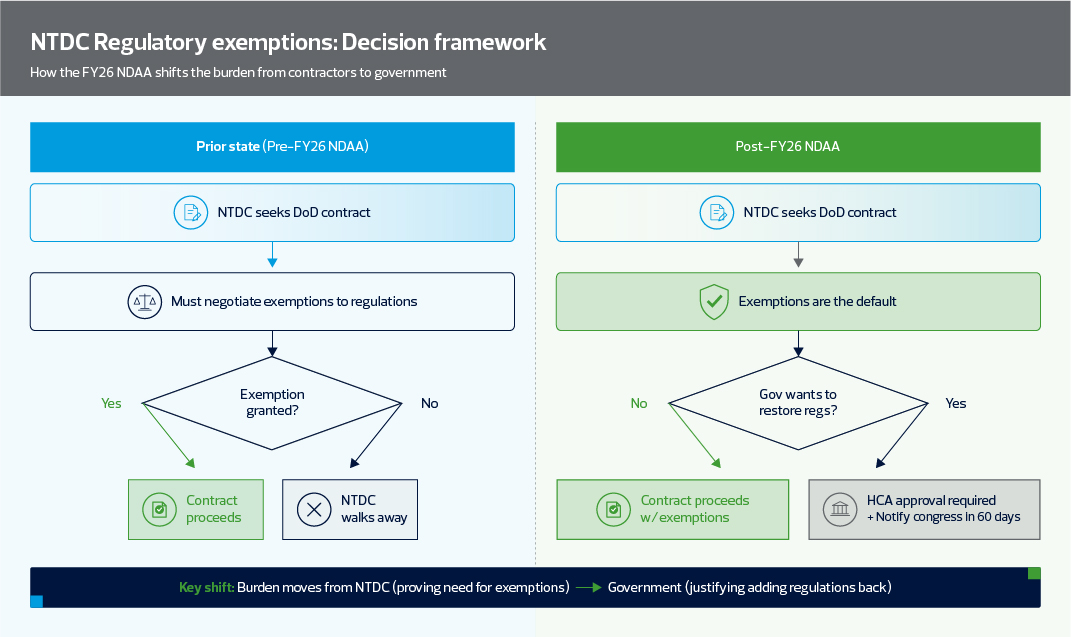
5442844_ig_nontraditional_defense_contractors
What did not change
Because statutory law overrides regulation, contracting officers must comply with section 1826 upon enactment, even before the FAR or DFARS are updated. However, until agencies issue guidance and train contracting officers, contractors should expect variation in how exemptions are interpreted and applied across contracting activities. As a result, contractors must be prepared to address nontraditional contractor exemptions during customer negotiations.
Importantly, nontraditional status does not exempt a company from all oversight or regulatory requirements. Statutory changes apply on a go-forward basis, but contractors must still comply with the terms and conditions of their existing awards.
Additionally, exemptions pertain only to DoD work. Other federal agencies may still impose complex requirements. DoD requirements, such as the Cybersecurity Maturity Model Certification (CMMC), may still apply.
While the FY26 NDAA significantly raised CAS thresholds—now $100 million for full CAS coverage and $35 million for the CAS contract threshold—contract coverage and thresholds continue to drive CAS applicability. Contracting officers retain discretion, documentation expectations still exist, and exemptions may be partially applied where justified. Nontraditional status changes the default starting point, but it does not eliminate accountability.
Flexibility is not the same as less risk
With new exemptions available by default, many nontraditional contractors face a familiar tension. Some may be tempted to build compliance structures that exceed their needs. Others will mistake flexibility for freedom from discipline altogether. The opportunity lies in between those extremes. The goal is to design an operating model that preserves flexibility while limiting future disruption.
Although statutory exemptions reduce prescriptive requirements, they increase reliance on contractor judgment. Risk does not disappear—it shifts from regulatory compliance to governance and documentation discipline.
Prior FAR-based contract experience does not mean the same framework governs new DoD work, and that distinction can create confusion about requirements. Consistency in accounting treatment and internal controls still matters, even absent CAS or FAR Part 31 requirements. Documentation becomes more important when regulations are less prescriptive—it demonstrates that decisions rest on sound business reasoning. Leadership must decide how much structure to maintain rather than default to legacy compliance models.
Designing minimum viable compliance
The objective is not deregulation; it is right-sized compliance—scalable fundamentals without overengineered systems. In practice, this means contractors should consider the following:
- Maintain disciplined labor tracking, even when full DFARS accounting system criteria do not apply.
- Preserve logical cost segregation to avoid rework if compliance expectations rise later.
- Document cost methodologies clearly enough to support transparency and price discussions.
- Avoid premature build-out—don't implement full DFARS business systems or adopt CAS-level rigor without a defined trigger.
- Separate commercial and defense cost structures to prevent regulatory spillover.
Government contracting compliance moves in cycles of deregulation and re-regulation. We are in a deregulatory phase that rewards streamlining, but history suggests contractors should maintain a foundational structure that can scale if necessary, rather than rebuild processes under pressure. Contractors should treat compliance decisions as strategic design choices, not reactive controls.
Pricing, flowdowns and prime relationships
The absence of certified cost or pricing data requirements does not eliminate the need to support price reasonableness. Contractors should document and consistently apply commercial pricing practices, with market data and benchmarking used in place of traditional cost build-ups. Firms must be prepared to explain pricing logic in plain language to contracting officers. Contractors should not default to cost-based pricing simply because it is familiar—standard costing or market-based pricing may be a better fit for commercial products and goods.
Prime contractors occasionally flow down requirements beyond what the statute mandates, often driven by their risk tolerance rather than legal necessity. Nontraditional contractors should distinguish between what is truly required and what is negotiable; overaccepting flowdowns can erode the benefits the exemptions provide.
Subcontractors performing core technical or high-dollar work may face greater pressure to adopt controls similar to those found in formal business systems, and a subcontractor viewed as integral to a prime contractor's ability to meet audit requirements may find the prime contractor's framework mirrored downstream. Early conversations with prime contractors can prevent unnecessary burdens.
The takeaway
The FY26 NDAA marks an important turning point. What was once a largely descriptive label is now strategically relevant, expanding flexibility for new entrants and experienced contractors who meet the statutory criteria. That flexibility is an advantage only if it is managed intentionally—through deliberate choices about what to adopt, what to defer and how to preserve optionality. In a future installment, we will address the question many companies avoid until it is too late: What happens when nontraditional status no longer applies?
RSM contributors
-
 Kristen BlandfordManager
Related insights
Contact our government contracting team today
Complete this form and an RSM representative will be with you shortly.