Revenue leakage often begins at cross-functional handoffs.

Key takeaways

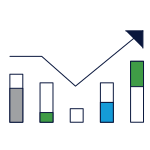
As leakage persists, growth can still increase, but profitability declines.

A revenue engine review can uncover hidden value and stimulate profitable growth.
Revenue leakage is costing organizations more than they realize
Revenue leakage is the value a business should capture but loses because of technology and process inefficiencies; pricing inconsistency; weak handoffs between marketing, sales, finance and operations; limited visibility; and execution challenges across the customer and seller journeys. It rarely appears as a single major problem. Instead, it shows up as a series of small inefficiencies that collectively reduce revenue quality and margin.
For middle market organizations, revenue leakage can be especially difficult to detect because the symptoms often resemble everyday operational friction. Deals move slowly through the pipeline. Discounting becomes ungovernable and/or creates a backlog of quote approvals. Customer onboarding challenges emerge after the sale, leading to frustrations from the customers. Marketing efforts generate activity that does not convert into meaningful growth. Revenue may still increase, but it often comes at a higher cost and lower return.
Where does revenue leakage show up first?
Revenue leakage typically appears where responsibility moves from one team to another. Every transition in the customer lifecycle creates an opportunity for value to be lost. A lead becomes an opportunity. An opportunity becomes a quote. A quote becomes an order. An order becomes a customer relationship. But the customer experience starts the moment a customer meets you, and then each handoff introduces risk.
Common examples of potential risks include:
- Pursuit of poorly qualified opportunities by sales teams
- Inconsistent pricing and discounting decisions
- Lost information during customer onboarding
- Limited visibility between marketing, sales, service and finance, creating a disconnected buyer experience
- Delays in quoting, contracting or fulfillment
These issues rarely exist in isolation. Each affects conversion rates, customer experience and profitability. Over time, the combined impact can become substantial.
Why revenue leakage is a margin issue, not just a sales issue
Many executives view revenue leakage as a sales execution problem. Often it is a margin problem.
A sales organization that pursues too many low-probability opportunities increases selling costs. Marketing programs that generate demand without conversion increase customer acquisition costs. Service teams that frequently resolve avoidable onboarding issues increase the cost to serve. Together, these factors reduce the financial return on investments.
The business question is not simply whether revenue is growing. The more important question is whether growth is creating enterprise value, and where companies can optimize processes to make the most of the resources they currently have.
Organizations that focus exclusively on pipeline volume or top-line revenue can miss warning signs that profitability is being weakened behind the scenes. Revenue leakage highlights the need to evaluate commercial performance through both a growth and margin lens.
What warning signs suggest the revenue engine is leaking value?
Leaders do not need perfect data to detect revenue leakage. They need visibility into how demand is created, converted, fulfilled and retained. Several indicators often signal that value is being lost.
Common warning signs include:
- Pipeline volume increases while win rates remain flat
- Discounting rises without a clear strategic rationale or clear approval process
- Forecast accuracy varies significantly across teams
- Opportunities stall during proposal, contracting or fulfillment
- Onboarding issues negatively affect customer retention
- Marketing and sales use different qualification criteria
- Reporting explains outcomes but not where value was lost
These indicators help leaders shift the conversation from assigning blame to identifying root causes. The objective is to understand where strategy, operations, technology and governance have become disconnected.
How can organizations identify and reduce revenue leakage?
The first step to addressing revenue leakage is to examine the entire commercial journey, from demand generation through renewal. Leaders should evaluate pricing decisions, approval workflows, sales-stage definitions, customer handoffs, billing accuracy and retention processes.
Organizations should also compare intended outcomes with actual behavior:
- Which customer segments receive the most attention?
- Which segments generate the strongest margins?
- Which products create unnecessary complexity?
- Where do deals frequently slow down and why?
- Which activities drive growth without improving profitability?
A comprehensive assessment requires shared metrics across functions. Conversion rates, sales velocity, discounting, retention, customer lifetime value and margin should be evaluated together. When departments optimize only their own metrics, revenue leakage often shifts from one area of the business to another rather than being eliminated.
Technology can support improvement efforts, but technology alone is not the solution. Sustainable results come from clear ownership, standardized processes, integrated workflows and consistent governance.
Why a revenue engine perspective matters
A revenue engine view connects customer experience, commercial execution, operational performance and financial outcomes into a single management framework. This broader perspective helps leaders distinguish between revenue growth that creates value and revenue growth that introduces complexity and cost.
Organizations often discover the biggest opportunities where decisions cross functional boundaries. For example:
- Pricing decisions may originate in sales but affect profitability
- Customer experience challenges may show up after onboarding, but actually begin during the sales process
- Marketing campaigns may deliver leads, but their business value depends on conversion quality and customer fit

You can’t fix revenue leakage you can’t see. Connecting customer, sales, service and finance data makes the gaps visible and actionable.
Leanne Tang, Director, RSM US LLP
Understanding these connections enables executives to focus on the issues that have the greatest impact on profitable growth.
What should executives do next?
Most organizations already have enough information to begin identifying revenue leakage. The challenge is rarely a lack of data. The challenge is connecting customer, operational and financial data to understand where value is being lost.
Leaders should start by developing a short list of priority areas of revenue risk and testing them against available data. For example:
- Compare discounting, pricing exceptions and approval patterns by segment and sales team
- Review aging opportunities by stage to identify stalled pipeline, conversion gaps and inconsistent follow-up
- Examine churn rates among customers acquired through different segments, product/service and customer experience, which may provide more actionable insight into the drivers of churn
- Analyze quote-to-cash cycle times for bottlenecks such as quote, contract, billing and renewal exceptions
- Identify handoffs with the highest rates of rework or delay
The goal is not to build a perfect model immediately. The goal is to identify where improved discipline and accountability can create measurable business value. Leakage isn't always a people/accountability issue; it can come from process, policy, technology, data and ownership gaps.
Revenue leakage is most often uncovered at the points where teams need to make decisions cross-functionally. These areas can reveal opportunities to protect existing revenue, improve margin and unlock incremental growth.
The takeaway
Revenue leakage across the customer and revenue lifecycle is often invisible because it appears as routine operational friction. Yet the cumulative impact can significantly reduce revenue growth, margin and enterprise value. Leaders who evaluate the entire revenue engine, from demand creation through renewal, are better positioned to identify where value is being lost and where it can be recovered.
The organizations most likely to achieve sustainable, profitable growth are those that reduce complexity, strengthen cross-functional alignment and treat commercial execution as a strategic business capability rather than a collection of disconnected activities. The objective is a connected revenue engine where leaders can see, measure and act on leakage across functional boundaries.
If your organization is growing but margin performance is not keeping pace, RSM can help assess where revenue leakage may be occurring and identify practical opportunities to improve commercial performance. Contact our team to learn more about how our revenue engine diagnostic works.
RSM contributors
Related insights
Frequently asked questions
Revenue leakage is value a company should capture but loses because of process, pricing, data, handoff or execution gaps across the customer journey.
Revenue leakage matters because it allows revenue growth to become less profitable as operational costs, inefficiencies and customer friction increase.
Executives should examine pipeline quality, discounting, quote-to-cash handoffs, onboarding, billing accuracy, customer retention and expansion opportunities.
Companies can reduce revenue leakage by mapping the revenue engine, aligning metrics, establishing clear ownership and connecting commercial activities to financial outcomes.
Contact our business strategy operations professionals
Complete this form and an RSM representative will be in touch shortly.